Ancient Sources in The Isle Fincara Trilogy
Ancient Sources in The Isle Fincara Trilogy
 by A G Rivett
A G Rivett describes how he drew on ancient sources in The Isle Fincara Trilogy.
In talking about the ancient sources I used in writing the Isle Fincara Trilogy, of course I want to mention those I used consciously. But there were also times when what I wrote mirrored something that existed without my knowing it. The most striking example is the Trilogy’s title. In the first book, The Seaborne, I simply called the medieval Celtic island of its setting ‘the Island.’ It was only later, when I was working on The Priest’s Wife, that I came to discover the old Irish myth of Fincara.
Fincara – an island beneath the waves
The Fincara of Irish legend is lost beneath the waves. The Celtic myths love journeys of their heros to many fantastic islands. P W Joyce in his 1897 classic, Old Celtic Romances, calls the telling of these tales simply ‘amusement’ or ‘entertainment.’ But I believe, as in C S Lewis’ 1952 book, The Voyage of the Dawn Treader, the stories are intended to parallel psycho-spiritual challenges. Here's a note from Joyce’s text: ‘The Gaelic tales abound in allusions to a beautiful country situated under the sea—an enchanted land sunk at some remote time, and still held under spell. In some romantic writings it is called Tir-fa-Thonn, the land beneath the waves.’ The Fincara of the Trilogy has not been cast beneath the waves. But its fate, at the close of the third book, The Shareg, is perhaps not so very different.
Source synergy – the women of Fincara
Joyce relates how Brian, son of Turenn, visited the island. ‘Then Brian put on his water-dress, with his helmet of transparent crystal on his head, and, telling his brothers to await his return, he leaped over the side of the ship, and sank at once out of sight. He walked about for a fortnight down in the green salt sea, seeking for the Island of Fincara; and at last he found it.’ Brian entered a large house. There he found, ‘beautiful ladies, busily employed at all sorts of embroidery and needlework.’ But when he tried to grab their cooking-spit, they laughed. Their leader warned, ‘the weakest among us would be able of herself to prevent thee.’ This has resonances with strong women in The Isle Fincara Trilogy, from the wise-woman Mother Coghlane in The Seaborne to Morag as she grows in confidence at the end of The Priest’s Wife. It also relates to Teigh nam Bân, the House of Women in The Shareg. This is where Amirah lives, in Sorcha’s words, ‘wi four or five other women, an they all work wi cloth in some way. Ye wit Amirah’s a dyer. An they’ve a weaver an a ’mbroid’r an—well, it’s a fair bonny place. There’s a tap’stry there, ye’d love it.’
Source synergy – the Monastic Community at Bangor Is-y-Coed
A second source synergy occurred when I learned of the former monastic community at Bangor Is-y-Coed (Bangor on Dee) in North Wales. While Caerpadraig is in no wise a monastic community—some of its inhabitants would laugh at the idea!—there are similarities. Not least because a monastic community in the Celtic church included families and was in that sense more like an intentional spiritual community than a monastery in today’s parlance. Vivien Lavis-Jones in History of Bangor Isycoed writes of ‘dwellings made of wickerwork,’ and ‘one hut, larger than the rest, that would have served as a church.’ This at least is like my Caerpadraig.
The 8th century chronicler Bede wrote about the monks of Is-y-Coed. He completed his Ecclesiastical History of the English People in 731 and records there how the community was suddenly destroyed around 616. A large number of monks who had gone out to the Battle of Chester to pray were slaughtered by order of King Aethelfrith of Northumbria. At the climax of The Shareg Caerpadraig is enmeshed in a power struggle that echoes certain aspects of the fate of Bangor Is-y-Coed.
Celtic Christians
When I was living in Scotland, partly in the Findhorn Community and partly on the Scoraig peninsula, I learned of the Céile Dé tradition and followed it for ten years. It claims to go back at least to the sixth century and retains many aspects of Druidic myth and practice, while incorporating the message of Christ. The epigraphs at the beginning of each book come straight from the Céile Dé tradition, and resonate with the emerging theme. There never was a Celtic Church as such, with a standardised liturgy and set of beliefs. But there were themes that bound Celtic Christians together. In its article on Celtic Christianity Wikipedia quotes a consensus view: ‘Celtic Christianity denied the authority of the Pope, was less authoritarian than the Catholic Church, more spiritual, friendlier to women, more connected with nature, and more comfortable dealing with Celtic polytheism.’ That’s a good description of the spirituality of my islanders.
Augustine of Canterbury brought ‘Roman’ Christianity to Britain very early in the 7th century, and summoned the Celtic leaders to meet him. There's a story about how he remained seated to receive them, and things went downhill from there. It’s a detail I pick up on at the beginning of The Shareg. See the article on St Augustine on the Aust Pilgrimage website.
The power of story; the cycle of the year
Any tradition is held together by the power of story. This is a powerful theme in the Trilogy, and the books contain several tales that are narrated by one character or another. Some of these are authentic Celtic myths, briefly re-told, and some I have unashamedly invented in the Celtic style.
The Céili Dé honour the cycle of the year, and this rhythm forms the underlying time-structure of the books. Throughout I had to be careful to avoid all artificial measures of time—and indeed of length—that permeate our own culture: mention of minutes, hours and seconds are out, as are miles; but days, months (moons) and years stay, together with distances measured in how long it might take you to walk somewhere—a morning’s journey, for instance.
The Land is the Backdrop
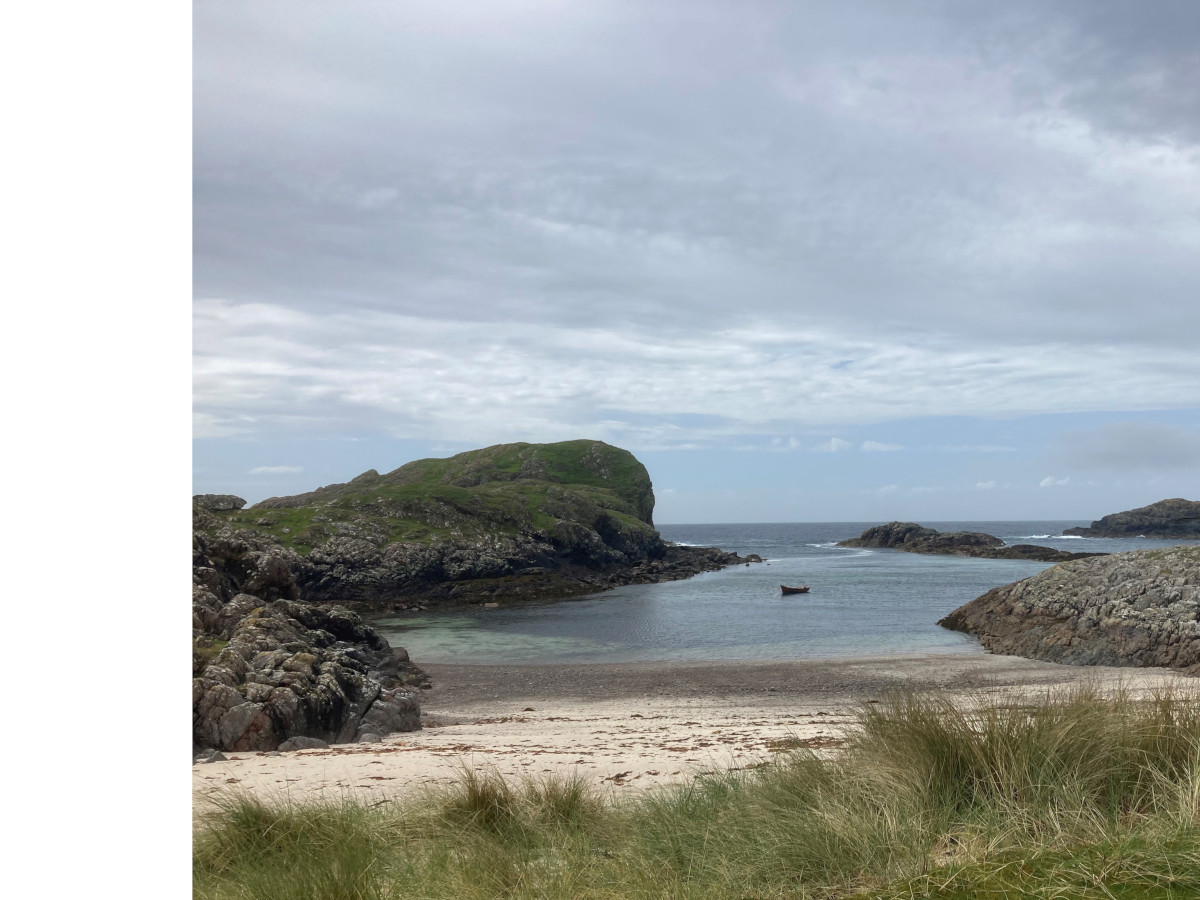
Throughout the Trilogy the land is the unvarying backdrop to everything that happens. While I was living on Scoraig, I learned that what you do and how you can do it are all dictated by the land, the sea and the weather. I like to think that my writing has grown out of the land. Perhaps that is why it has absorbed so many ancient sources, which also have sprung from the same native soil.
A G Rivett
Read more about the Isle Fincara Trilogy.
The Isle Fincara Trilogy is published by Pantolwen Press
Books 1 and 2, The Seaborne and The Priest’s Wife are out.
Book 3, The Shareg, is due to launch in October 2026.