
The Isle Fincara Trilogy
The Isle Fincara Trilogy begins and ends as a Celtic portal fantasy. In between, it’s a spiritual odyssey with aspects of alternative history. It draws strongly on Scottish landscape and old Celtic traditions. And at its heart is a London engineer.
In Irish legend, druidic magic cast the original Fincara beneath the waves. Down in that watery world, redoubtable women sit sewing in their houses, undeterred. Fincara of the Trilogy remains above the waves. Yet its fate, in the end, is perhaps a variation on a theme. Read more in the Blog post, Ancient Sources in the Isle Fincara Trilogy.
Each book stands alone
Each book stands alone, but together they form a narrative arc. All are set on the Island and many of the same characters reappear throughout, stepping in and out of prominence as events ebb and flow.
In The Seaborne a 21st century man is washed up on a medieval island. Nothing he’s ever learned prepares him for what he finds: a place where everything must be done by hand and on foot. A community that seems at peace with itself, and changes him.
The perspective shifts with The Priest’s Wife to a woman’s journey and a quest that starts in grief and ends in emancipation. The peace of the Island is now under threat from the arrival of a powerful incomer: the new archpriest. Here A G Rivett picks up on historical tensions between Celtic and mainstream church traditions, and transposes them to his fictional world.
In the final book, The Shareg, the tensions come to a head. Characters are caught like flotsam in a storm as an authoritarian church sweeps away the old ways. A resistance movement fights back, but can it do more than buy time?
The Island’s Guardians hold the wisdom. The wise woman, Mother Coghlane, is the first to appear. We meet her in The Seaborne, where she lives in a bothy deep in the mountains. The Priest’s Wife introduces the whole circle of the Guardians, who reappear in The Shareg, drawing on a deeper wisdom, and changing everything.
The Trilogy arises out of lived experience
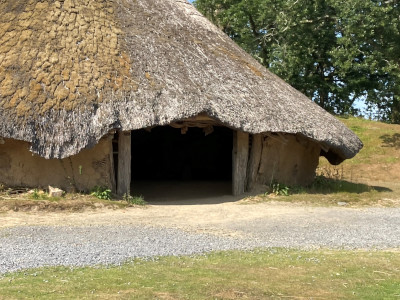
The Trilogy arises out of lived experience. As a young doctor Rivett worked in rural north-eastern Nigeria and witnessed a way of life that was technologically much simpler than he’d known. Many of his patients lived in thatched roundhouses, and he learned what it feels like to be the stranger. These memories fed into The Seaborne and mingled with Rivett’s later experience, living in the Scottish Highlands where the landscape spoke to him powerfully. There, he met and followed the ancient tradition of the Céile Dé. He lived and worked an off-grid croft on the Scoraig peninsula. And, during his time at the Findhorn community, encountered shamanism.
Morag’s story in The Priest’s Wife rises from Rivett’s experience as a minister in the Church of England. He was ordained as a deacon in the late 1980s, along with the first group of women deacons. It would be another seven years before women were ordained as priests and, at the ordination ceremony the following year, he experienced their absence as a shock. This memory fuelled The Priest’s Wife.
Returning to medicine, Rivett ended his professional life as a public health doctor. He draws on experience, both as practitioner and patient, in charting the ills that affect his characters. His time in ministry suggested Father Hugh in The Seaborne but also gave him the perspective to witness power struggles that feed into The Shareg.
Under and over all is the land
Under and over all are the rugged landscapes of the north and west of the British Isles. The mountains, bogs, rivers and loughs, and the people and other beings – physical and spiritual – who live there. The Isle Fincara Trilogy is about individuals and community. Earthy realities and spiritual necessities. The land, and all who depend on it. The beliefs and traditions that knit them together.


