Penda’s Fen to the Isle Fincara Trilogy
Penda’s Fen to the Isle Fincara Trilogy
 by Gillian Paschkes-Bell
Penda’s Fen was on just before the release of The Shareg
Penda’s Fen was on iPlayer shortly before the release of The Shareg, the final book of A G Rivett’s Isle Fincara Trilogy. We were struck by a similarity of themes: in particular, the mixing and merging of pagan and Christian elements in the film, as in the trilogy.
Penda’s Fen is a British film set in 1973, a cult classic. Hailed as visionary, it’s a mystical, mysterious narrative where apparition, dream and everyday reality mix and merge. It charts the total turnaround of Stephen Franklin from self-righteous, judgemental adolescent to one who has gone the difficult journey of seeing through the social norms of his time. Set in Worcestershire, the eponymous Penda was a real seventh century Anglo-Saxon King of Mercia—the last pagan English king.
The Isle Fincara Trilogy begins in 21st century London, but swiftly transitions to a Celtic isle in a parallel world like ours of the eleventh century. John Finlay, the main character, is a Londoner on the run, who finds himself plunged into a radically simpler world and a life lived closer to the earth. He must learn to adapt to Island life in a world King Penda would have understood. In The Shareg, that world is faced by the threat of a take-over bid from establishment figures from the mainland.
There’s more about the Isle Fincara Trilogy elsewhere on this website, so I focus now on Penda’s Fen.
The Opening—we meet Stephen
The opening words are heard across fields of waving corn, the Malvern hills rising in the background. They express, ‘my wish to serve my country.’ We cut from there to a rural church, seen at a dramatic angle, and at last to its Victorian rectory and an ear-splitting extract from Elgar’s Dream of Gerontius. It’s that moment when Gerontius is brought into the presence of God. The awe and wonder is almost unbearable and we are made to feel that. Then, suddenly, we’re back in the world of everyday as Stephen’s mother lifts the arm of the record-player. ‘We like you to like good music, Stephen,’ she remonstrates. ‘But it was awfully loud’. This is our introduction to seventeen-year-old Stephen.
Two Debates
We see Stephen in different guises: dressed as a cadet and jeered at by Joel, the milkman; in school assembly, himself playing the organ for the whole school; in a formal debate—defending the nation against atheism.
Another debate, in the village hall. This time Stephen is in the audience listening to Arne, a local playwright, defend the strikers of those days, cataloguing how it’s the establishment rather than the strikers who have held the people to ransom. At the end of a sizeable list, he cites the calculation of ‘acceptable losses’ in time of war. At this, a military figure on the panel appeals to Stephen’s father, the Reverend J Franklin, chairing the meeting: ‘Do we have to listen to this?’
Visions and Dreams—Because I am Two Selves
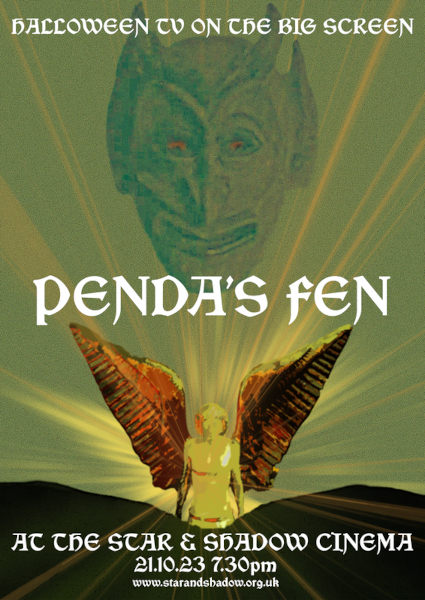
Stephen is prone to visions and dreams. Several visionary scenes involve burning and one a bloody chopper, but the symbolism may not register at once. It’s a film that repays repeated viewing. These visions and his awakening homo-eroticism, together with the discoveries he makes about his own family, relentlessly erode the opinions he holds at the outset. As he lies in bed or rests beside a pool or cycles down a country lane, suddenly a golden angel or a black demon appears to him. He’s seen them in dreams, too, and asks his father, ‘Can dreams come true?’
‘Dreams are true,’ comes the reply. ‘They tell us a truth about ourselves.’
When Stephen asks his father, ‘Do you believe in God?’ his reply is, ‘I believe in Truth.’
‘Then why do you stay frocked?’ Stephen demands.
‘Because I am two selves.’
Aren’t we all at least two selves? The public selves we construct to function in the world; the inner self that dwells in the heart?
Changing Attitude
Stephen’s inner shift takes outward form in his changing attitude to Arne and his wife. The Arnes are a childless couple and the Stephen we first meet suggests that God denied them children as retribution for their wrong views.
‘Stephen, you can be grotesque sometimes!’ remonstrates his mother.
Later he softens, watching Mrs Arne apply a herbal remedy to a kitten. At school as well, we see him change: skulking in his cadet kit in a locker room, before being lectured on his growing uselessness to society.
Penda and Christ – a Sympathetic Synergy
Penda’s Fen is a film where place is as important as character. Pinvin, where Stephen lives, is a real village and we learn that the name is a corruption of Penda’s Fen. It is Arne (of course) who lets us know how once ecologically-rich, wild fenland was drained to turn it into productive agricultural land. As for the name Penda, the Wikipedia article suggests two possible etymologies, one Celtic, the other Germanic. Within the context of the film, with the Malvern hills rising as a backdrop, the Celtic option feels much the more persuasive. In Welsh, pen = head, or top + da = good. So you might come up with a meaning like Highest Good. This would fit the closing scenes in which images of Penda and Christ are brought together in a sympathetic synergy, like the stained glass window dedicated to Penda in Worcester cathedral.
King Pendas’s Court was Multi-ethnic and Tolerant
Wikipedia is interesting on this point: ‘Penda’s court would have been cosmopolitan, multi-ethnic, multi-lingual and tolerant,’ the article states. Even Bede, no friend of pagans, is quoted as having written: ‘Nor did King Penda obstruct the preaching of the word among his people… but…hated and despised those whom he perceived not to perform the works of faith, when they had once received the faith, saying, They were contemptible and wretched who did not obey their God, in whom they believed.’ But, we read, the Historia Brittonum took a different view and held that Penda prevailed in battle ‘through diabolical agency.’ It is the Reverend J Franklin who suggests that when a new religion vanquishes old gods it has to see them as diabolical.
Christianity’s Many Variants
Like the self, Christianity has many variants. In the Gospels, Christ tells us to become ‘as children.’ (Matthew 18:3) But he also tells us to be ‘wise as serpents and harmless as doves.’ (Matthew 10.16) Taken together, surely the child-quality Jesus calls for is openness of heart, free from the encrustment of social convention, not the childishness of ignorance. When we first meet Stephen, he has already taken on a distorting crust of received views and hands out judgement against any who challenge convention. By the end of the film, he has changed, is self-righteous no more. In a scene that mirrors the temptation of Christ, with an pair of establishment figures in the role of Tempter, Stephen protests: ‘I am nothing pure! My race is mixed! My sex is mixed! I am woman and man, light with darkness. Mixed!’ In this, his sight is cleansed. As he flees, King Penda appears to him in a vision and the old king’s words chime with Huxley’s Brave New World as he declares that Stephen’s tempters, ‘would have us children forever.’
Synergy between Christ and the pagan elements
The end of Penda’s Fen expresses a synergy between Christ and the pagan element. As Stephen sits alone in a church, the voice of King Penda is heard through a widening crack in the floor; meanwhile, Christ’s nailed and bloodied feet suddenly appear in the mirror by the organ.
Since the Roman Empire adopted Christianity as state religion, the relationship between Christianity and pagan traditions has been strained indeed. At its most intolerant, Empire suppressed pagan traditions in the Roman world, and often did it violently. Only beyond the reach of Empire have gentler missionaries been content to share their stories, leaving it to their native hosts to take from them whatever seems good to them.
This gentler process in what happened in the Celtic lands of the British Isles, too, in the years before Augustine of Canterbury came on the official mission. The Céile Dé or Culdee is a notable survivor of those traditions, carried orally down the years in out-of-the-way places. Such traditions have left behind them a wake that ripples through the currents of the Isle Fincara Trilogy. In the first book, The Seaborne the Islanders see Christ within their old traditions, not at odds with them. But in the later books, The Priest’s Wife and The Shareg, their new Archpriest, a forerunner of the establishment figures of Penda’s Fen, takes a different view.
But, in the end, neither King Penda nor the Guardians of the Isle Fincara can arrest the destructive dynamics built into our social and government systems. We leave them both, waiting out the ages, for a time when that momentum will have burnt itself out.
Gillian Paschkes-Bell
September 2026
Penda’s Fen was written by David Rudkin and directed by Alan Clarke. Stephen was played by Spencer Banks. It was released in 1974 as a Play for Today.
The three books of the Isle Fincara Trilogy by A G Rivett were published between 2019 and 2026. A second edition of The Seaborne, the opening book, came out in 2022 after the liquidation of its original publisher, Wordcatcher.